Converting Existing Structures into Tilapia Production Ponds: A Practical Guide for Farmers
Posted on: 2025-11-10
By: Yomi Adisa
Converting Existing Structures into Tilapia Production Ponds: A Practical Guide for Farmers
You're walking around your farm, looking at that old concrete water tank that's been sitting empty for two years, or perhaps that abandoned irrigation channel that once watered your crops. What if those forgotten structures could become productive tilapia ponds generating steady monthly income? Most farmers don't realise that converting existing infrastructure represents one of the most cost-effective ways to enter profitable tilapia farming.
📑 Table of Contents
Rather than spending 200,000 to 500,000 naira for new pond construction in Lagos, or 800,000 to 1.2 million shillings in Kampala, you can often convert existing structures for just 30-60% of that investment. This approach transforms unused assets into income-generating systems whilst dramatically reducing your startup costs. The challenge lies in knowing which structures can be successfully converted, how to modify them properly, and what management practices ensure productive tilapia farming.
Converting structures isn't simply about filling them with water and adding fish. Success requires understanding structural assessment, proper pond design modifications, water quality management systems, optimal stocking procedures, and feeding regimes specific to converted environments. Get these elements right, and you can achieve production levels matching purpose-built ponds at a fraction of the cost.
This comprehensive guide provides you with complete technical knowledge for transforming unused structures into thriving tilapia production systems. You'll learn exact processes for evaluating structural suitability, calculating modification requirements, implementing water management systems, and managing fish production from stocking through harvest. By the end, you'll have the expertise to convert existing infrastructure into profitable tilapia farming operations.
🎯 What You'll Learn
- colour: #343A40;">Learn how to assess and modify existing structures for safe and effective tilapia production
- colour: #343A40;">Master the principles of optimal pond design to enhance water circulation and fish health
- colour: #343A40;">Discover effective feeding strategies and nutritional requirements to maximise tilapia growth and profitability
Assessing Existing Structures for Conversion
Before you begin any conversion work, you must thoroughly evaluate whether your existing structure can safely and effectively support tilapia production. This assessment phase determines your project's feasibility and helps you understand exactly what modifications you'll need. The evaluation process involves examining structural integrity, understanding regulatory requirements, and considering environmental factors that will affect your fish production success.
Types of Structures Suitable for Conversion
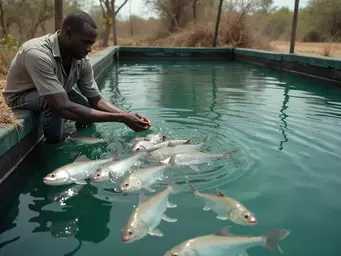
Abandoned concrete reservoirs represent excellent conversion candidates because they're already designed to hold water and typically feature proper depth for tilapia production. Look for reservoirs between 1.2 to 2.5 metres deep with surface areas of at least 30 square metres. A farmer in Ibadan converted a 100-square-metre concrete reservoir originally built for irrigation storage, creating a productive tilapia pond that now generates 180,000 naira annually.
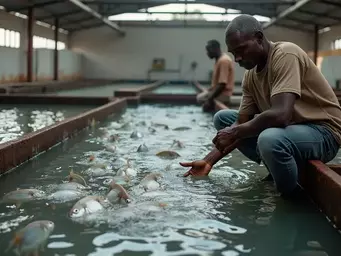
Concrete tanks, whether originally designed for water storage or industrial use, offer controlled environments perfect for intensive tilapia production. Rectangular tanks work best, with dimensions allowing easy netting and maintenance access. Circular tanks can work but present challenges during harvesting. Consider tanks with volumes between 20 to 200 cubic metres for optimal management.
Irrigation canals and channels can become productive pond systems with proper modification. You'll need to install barriers to create contained sections and ensure adequate depth throughout. Channels work particularly well for flow-through systems where you can maintain water circulation. A cooperative in Mwanza converted 200 metres of abandoned irrigation channel into six connected tilapia ponds, each measuring 25 metres by 4 metres with 1.5-metre depth.
| Pond Type | Advantages | Disadvantages |
|---|---|---|
| Concrete Reservoirs | Already holds water, minimal modifications | Requires cleaning and minor repairs |
| Concrete Tanks | Controlled environment, stable temperatures | Harvesting challenges with circular tanks |
| Irrigation Channels | Good for flow-through systems | Requires installation of barriers and depth management |
Evaluating Structural Integrity
Inspect your structure's walls, floor, and any existing plumbing for cracks, particularly hairline fractures that might expand under water pressure. Fill the structure with water and monitor for 48 hours, marking any areas where water levels drop. Minor cracks can be sealed with waterproof cement, but major structural damage requiring extensive repair might make conversion uneconomical.
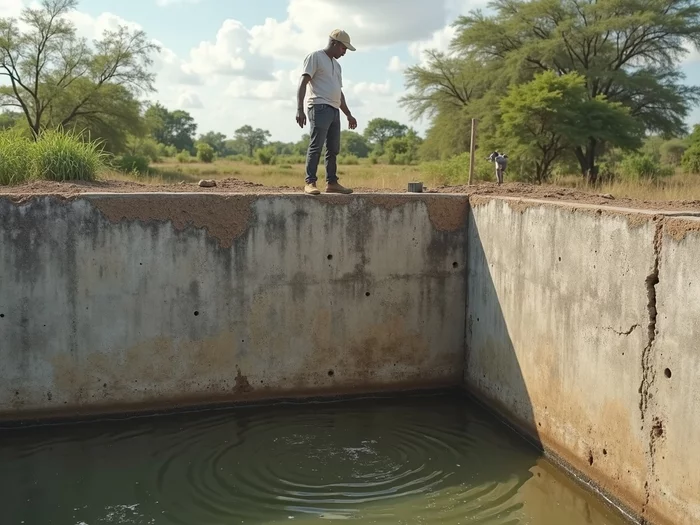
Examine the foundation and surrounding soil for stability. Look for signs of settling, erosion, or soil movement that could compromise structural integrity. Test drainage around the structure to ensure water won't accumulate and weaken foundations. If your structure sits on clay soil, verify that seasonal expansion and contraction haven't created structural stress.
Assess existing inlet and outlet systems for functionality. Original plumbing might serve your tilapia operation with modifications, saving considerable installation costs. Check pipe conditions, valve operations, and drainage capacity. Your outlet system must handle complete pond drainage for harvesting and emergency water changes.
Environmental and Regulatory Considerations
Contact your local fisheries department to understand aquaculture licensing requirements and water use regulations. In Kenya, you'll need permits from the Kenya Marine and Fisheries Research Institute, whilst Nigerian farmers must register with state fisheries departments. Some regions require environmental impact assessments for structures exceeding certain sizes.
Consider your water source sustainability and rights. If you're using borehole water, verify your pumping rights and calculate ongoing costs. Surface water sources require permits and consideration of downstream users. Calculate your daily water requirements - a 50-square-metre pond needs approximately 75,000 litres for initial filling plus 5-10% daily replacement.
Evaluate environmental factors affecting your conversion success. Consider proximity to residential areas regarding potential odour or noise concerns. Assess flood risks and drainage patterns that might affect your pond during heavy rains. Plan for waste water management - you'll need proper disposal methods for pond water during cleaning and harvesting.
Designing the Converted Tilapia Production Pond
Converting existing structures requires careful design modifications to create optimal conditions for tilapia production whilst working within your structure's constraints. Your design decisions directly impact stocking density, feeding efficiency, water quality management, and ultimately your production success. Understanding fundamental pond design principles helps you maximise your existing structure's potential whilst avoiding costly mistakes that could compromise fish health and growth rates.
Pond Design Fundamentals
Tilapia ponds require specific depth ranges for optimal production, with 1.2 to 2.0 metres providing ideal conditions for growth and management. Depths below 1.2 metres experience excessive temperature fluctuations and reduced dissolved oxygen levels, whilst depths exceeding 2.5 metres become difficult to manage and may develop oxygen-depleted bottom layers. If your existing structure is too shallow, you can excavate to increase depth, but ensure structural walls can handle the additional soil pressure.
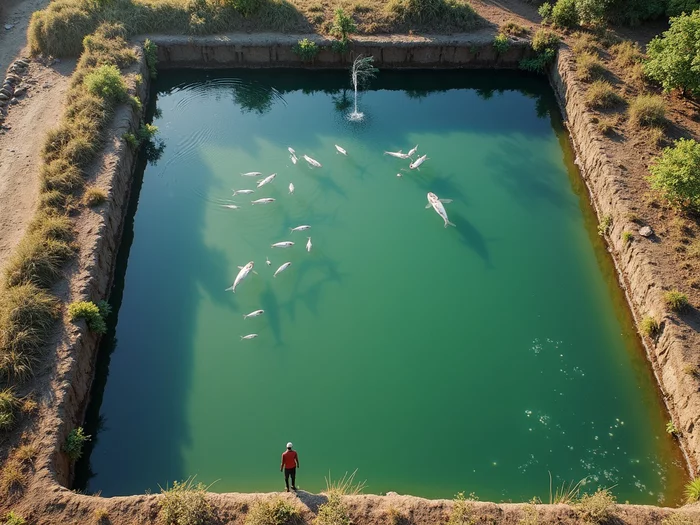
Pond shape significantly affects water circulation and management efficiency. Rectangular ponds with length-to-width ratios between 2:1 and 4:1 provide optimal water flow patterns and easy netting access. If you're working with irregular shapes, consider installing internal barriers to create more manageable sections. Avoid sharp corners where debris and waste can accumulate - round corners or install corner drains for better water circulation.
Install proper inlet and outlet systems for effective water management. Position inlets at one end and outlets at the opposite end to encourage water flow throughout the pond. Your inlet should introduce water gently to avoid disturbing fish and should be positioned to prevent erosion of pond walls or bottom. The outlet system requires both surface and bottom drains - surface drains for normal water level management and bottom drains for complete emptying during harvest and cleaning operations.
Soil Type and Preparation
Examine your existing structure's bottom material and plan necessary preparations for tilapia production. Concrete bottoms require thorough cleaning to remove any chemical residues from previous use, followed by neutralisation if the concrete is new and highly alkaline. Test pH levels and apply agricultural lime if needed to buffer alkalinity. Allow concrete to cure and weather for at least 30 days before stocking fish, or accelerate the process by filling, draining, and refilling several times.
If your structure has an earthen bottom, test soil composition and pH levels. Clay soils with 20-30% clay content provide excellent pond bottoms that hold water and nutrients effectively. Sandy soils drain too quickly and require clay amendments or plastic lining. Test soil pH - optimal range for tilapia production is 6.5 to 8.5.
Prepare earthen bottoms through proper drying and treatment procedures. Remove all vegetation and organic debris that could decompose and create water quality problems. Sun-dry the bottom for 2-3 weeks if possible, which eliminates harmful bacteria and parasites whilst improving soil structure. Apply lime if soil tests indicate need, working it into the top 10 centimetres of soil.
Water Quality Management
Evaluate your available water sources and plan treatment systems for optimal tilapia production. Borehole water typically requires minimal treatment but test for pH, hardness, and dissolved minerals. Surface water from rivers or lakes needs more extensive treatment including filtration and possible chlorination followed by dechlorination. Well water might contain high iron levels requiring aeration and settling before use.
Install aeration systems appropriate for your pond size and stocking density. Paddle wheel aerators work well for larger converted structures, providing both oxygenation and water circulation. For smaller conversions, consider fountain aerators or air stone systems powered by electric blowers. Calculate aeration needs based on stocking density - provide 1-2 horsepower per hectare for intensive production systems.
Monitor critical water quality parameters that determine tilapia health and growth rates. Maintain pH between 6.5 and 8.5, with optimal range of 7.0 to 8.0 for maximum growth. Keep dissolved oxygen levels above 5 mg/L at all times, with 6-8 mg/L optimal for intensive production. Monitor temperature daily - tilapia grow best at 26-30°C, with growth slowing significantly below 20°C or above 35°C.
| Parameter | Optimal Range | Monitoring Frequency |
|---|---|---|
| pH | 6.5 - 8.5 | Weekly |
| Dissolved Oxygen | >5 mg/L | Daily |
| Temperature | 26 - 30°C | Daily |
| Ammonia | <0.5 ppm | Weekly |
| Nitrite | <0.1 ppm | Weekly |
Stocking and Breeding Practices
Successful tilapia production in converted structures depends heavily on proper stocking procedures and understanding breeding management techniques. Your stocking decisions affect growth rates, feed conversion efficiency, and final harvest weights. Whether you choose to prevent breeding through sex reversal or manage breeding through controlled collection, these practices determine your production system's profitability and sustainability.
Selecting Tilapia Species and Stocking Density
Nile tilapia represents the most productive choice for intensive pond systems, offering rapid growth rates and excellent feed conversion ratios. This species reaches 300-400 grams in 6-7 months under optimal conditions and adapts well to various water conditions. Blue tilapia grows slightly slower but tolerates cooler temperatures better, making it suitable for higher altitude locations. Consider GIFT (Genetically Improved Farmed Tilapia) strains where available - these selectively bred Nile tilapia grow 20-30% faster than standard strains.
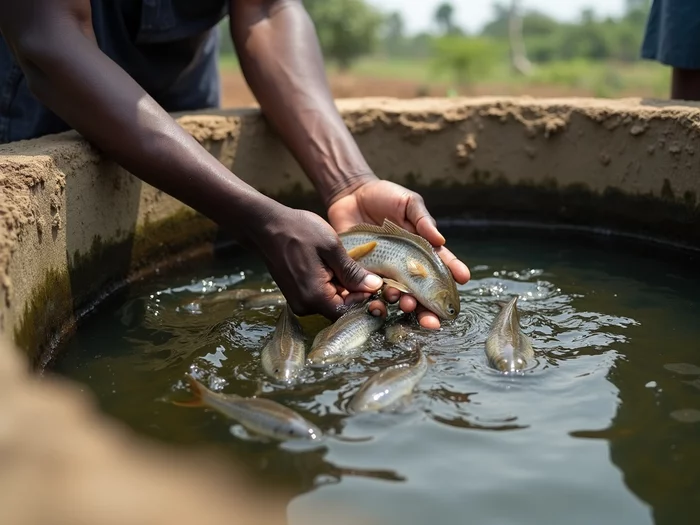
Calculate stocking density based on your pond size, aeration capacity, and intended management intensity. For converted structures with good aeration, stock 100-150 fingerlings per square metre for intensive production. Without supplemental aeration, reduce density to 50-80 fingerlings per square metre to prevent oxygen depletion. Higher densities require more frequent water changes, better feed management, and closer monitoring.
Source fingerlings from reputable suppliers offering sex-reversed fry to prevent unwanted breeding in your production pond. Sex-reversed fingerlings cost 8-15 naira each in Nigeria or 12-20 shillings in Kenya but eliminate breeding problems that reduce growth rates and complicate harvesting. If using mixed-sex fingerlings, plan for breeding management or accept lower individual fish weights due to energy diverted to reproduction.
Fingerling Acquisition and Handling
Purchase fingerlings from established hatcheries with good reputations for healthy, properly sized stock. Inspect fingerlings before purchase - they should be active, uniform in size, and free from visible injuries or diseases. Avoid fingerlings showing signs of stress such as gasping at the surface, erratic swimming, or pale colouration. Quality fingerlings cost more initially but provide better survival rates and growth performance.
Transport fingerlings in well-oxygenated containers to minimise stress and mortality. Use plastic bags filled one-third with water and two-thirds with oxygen, or transport in well-aerated tanks with battery-powered aerators. Maintain water temperature during transport and avoid overcrowding - transport no more than 100 fingerlings per 20-litre container for trips under 2 hours.
Acclimatise fingerlings properly before releasing them into your converted pond to prevent temperature and pH shock. Float transport containers in your pond for 15-20 minutes to equalise temperatures gradually. Slowly add pond water to transport containers over another 15-20 minutes to adjust pH and water chemistry differences. Release fingerlings gently during cooler parts of the day, preferably early morning or late afternoon when water temperatures are stable and dissolved oxygen levels are higher.
Breeding Techniques and Fry Collection
If you choose to allow breeding in your production system, install breeding cages or designated areas where you can easily collect fry before they compete with growing fish for food and space. Construct breeding cages from fine mesh materials suspended in your pond, allowing water flow whilst containing breeding pairs. Use cages measuring 2 metres by 1 metre by 1 metre deep, providing adequate space for territorial behaviour whilst enabling easy fry collection.
Collect fry regularly every 2-3 weeks to prevent overpopulation and competition with market-size fish. Female tilapia carry fry in their mouths for 10-14 days after fertilisation, then release them to forage independently. Watch for females with distended mouths indicating mouth-brooding behaviour. Gently net these females and strip fry by carefully opening their mouths over a container of pond water.
Rear collected fry in separate nursery systems until they reach 1-3 grams before introducing them to main production ponds or selling to other farmers. Use smaller containers or sectioned areas of your pond with fine mesh barriers. Feed fry with high-protein starter feeds containing 35-40% protein, feeding small amounts 4-5 times daily. Maintain excellent water quality in nursery areas with frequent partial water changes.
Feeding Regimes and Growth Optimisation
Proper feeding management determines your tilapia production success more than any other single factor in converted pond systems. Understanding nutritional requirements, calculating appropriate feeding rates, and monitoring growth responses allows you to optimise feed conversion whilst maintaining healthy fish populations. Effective feeding strategies can mean the difference between profitable operations and financial losses.
Feed Types and Nutritional Requirements
Commercial tilapia feeds provide consistent nutrition and predictable growth results, though they represent your largest ongoing operational cost. Choose feeds containing 28-32% protein for growing tilapia, with higher protein levels for smaller fish and lower levels for larger fish approaching harvest size. Quality feeds cost 280-350 naira per 25kg bag in Lagos or 1,200-1,500 shillings in Nairobi but provide feed conversion ratios of 1.5:1 to 2.0:1 when used properly.
Supplement commercial feeds with locally available ingredients to reduce costs whilst maintaining nutrition quality. Rice bran, wheat bran, and maize meal provide carbohydrate energy sources when mixed with protein-rich ingredients like fish meal, soybean meal, or groundnut cake. A successful mixture contains 30% protein sources, 40% carbohydrate sources, and 30% commercial feed to maintain balanced nutrition.
Formulate homemade feeds when commercial feeds are unavailable or too expensive, but ensure proper protein levels and ingredient quality. Mix fish meal (50%), maize meal (25%), rice bran (15%), soybean meal (8%), and vitamin premix (2%) for a balanced 32% protein feed. Grind ingredients to appropriate particle sizes - 2-3mm for fingerlings, 4-6mm for growing fish. Store homemade feeds in dry, rodent-proof containers and use within 30 days to prevent spoilage and nutrient degradation.
Feed Conversion Ratio (FCR) and Feeding Strategies
Calculate your Feed Conversion Ratio by dividing total feed consumed by total fish weight gained - an FCR of 1.8 means you need 1.8 kilograms of feed to produce 1 kilogram of fish. Target FCRs between 1.5-2.2 for efficient tilapia production, with better ratios indicating more efficient feed utilisation and higher profitability. Monitor FCR monthly by weighing sample fish and calculating average weights, then comparing to feed consumption records.
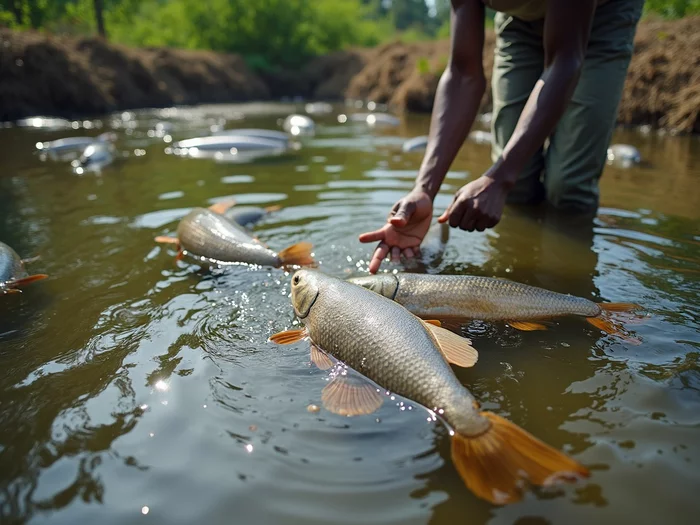
Feed tilapia 3-4% of their estimated body weight daily, divided into 2-3 feeding sessions throughout the day. Adjust feeding rates based on water temperature - reduce to 2% of body weight when temperatures drop below 20°C, increase to 4-5% during optimal temperature periods of 26-30°C. Feed early morning and late afternoon when fish are most active and dissolved oxygen levels are adequate.
Observe fish feeding behaviour to adjust feeding quantities and prevent waste that degrades water quality. Healthy tilapia should consume all feed within 15-20 minutes of feeding. If feed remains uneaten after 30 minutes, reduce the next feeding amount by 20%. Conversely, if fish consume feed immediately and continue searching for more, gradually increase feeding rates.
| Fish Size (grams) | Daily Feeding Rate (% of body weight) | Recommended Feeding Frequency |
|---|---|---|
| 1-3 grams | 3-4% | 3-4 times |
| 10-100 grams | 2-3% | 2-3 times |
| 100-300 grams | 1.5-2% | 2 times |
| >300 grams | 1-1.5% | 1-2 times |
Monitoring Growth and Health
Weigh sample fish monthly to track growth rates and adjust feeding programmes accordingly. Net 20-30 fish randomly from different areas of your pond, weigh them individually, and calculate average weights. Healthy tilapia should gain 15-25 grams per month under good management conditions. Record weights, feeding rates, and water quality parameters to identify trends and optimise your management practices.
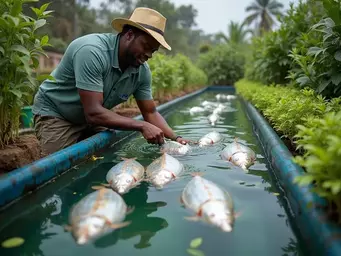
Monitor fish behaviour daily for early detection of health problems or environmental stress. Healthy tilapia swim actively throughout the water column, respond quickly to feeding, and display bright colours. Warning signs include fish gasping at the surface, swimming erratically, showing pale colours, or refusing food. These symptoms often indicate poor water quality, disease onset, or overcrowding requiring immediate management response.
Conduct regular health assessments by examining fish for external parasites, injuries, or disease symptoms. Look for white spots indicating ich parasites, red sores suggesting bacterial infections, or damaged fins from fighting or poor water quality. Maintain detailed records of fish health observations, treatments applied, and outcomes achieved. Early intervention prevents minor problems from becoming major losses - treating ich with salt baths costs much less than replacing dead fish from untreated infections.
| Disease | Symptoms | Treatment |
|---|---|---|
| Ich | White spots on skin | Salt baths |
| Bacterial Infections | Red sores | Antibiotics |
| Stress | Erratic swimming, gasping | Improve water quality, reduce stocking density |
Harvesting and Post-Harvest Practices
Successful harvesting requires careful timing, proper techniques, and immediate post-harvest handling to maintain fish quality and maximise market value. Your harvesting approach affects final fish weights, survival rates during handling, and ultimately your profitability. Understanding when and how to harvest, combined with proper post-harvest practices, ensures you capture the full value of your production efforts.
Timing and Techniques for Harvesting
Harvest tilapia when they reach optimal market size of 300-500 grams, typically achieved in 6-8 months depending on stocking density, feeding rates, and water quality management. Monitor average weights through monthly sampling to determine harvest timing precisely. Harvesting too early reduces total production weight, whilst delaying harvest increases feed costs without proportional weight gains. A farmer in Kano discovered his optimal harvest timing at 7 months when fish averaged 380 grams, providing the best balance between growth rate and feed efficiency.
Prepare for harvest by reducing feeding 24-48 hours beforehand to empty fish digestive systems and improve meat quality. Lower water levels gradually to concentrate fish and make netting easier, but maintain adequate depth to prevent stress. Check weather conditions and plan harvest during cooler parts of the day to reduce fish stress and maintain quality. Early morning harvesting typically provides the best conditions with stable temperatures and higher dissolved oxygen levels.

Use appropriate netting techniques for your converted pond structure. Seine nets work well in rectangular ponds, allowing systematic fish collection from one end to the other. For circular or irregular structures, use multiple smaller nets to corner fish in manageable groups. Handle fish gently during netting to prevent injuries that reduce market value. Sort fish by size during harvest, separating market-ready fish from those requiring additional growing time.
Post-Harvest Handling and Storage
Process harvested fish immediately to maintain freshness and market quality. Kill fish humanely using ice water or percussive stunning to prevent stress-induced quality deterioration. Clean fish thoroughly, removing scales, guts, and gills according to market requirements. Some markets prefer whole fish whilst others require cleaned and filleted products. Understanding your target market's preferences maximises your selling price and reduces waste.
Store processed fish at proper temperatures to prevent spoilage and maintain quality. Use ice at a ratio of 1:1 fish to ice weight for short-term storage up to 24 hours. For longer storage, consider freezing facilities if available, though fresh fish typically commands higher market prices. Package fish appropriately for your distribution method - plastic bags for local markets, insulated containers for longer transport distances.
Plan your marketing and distribution strategy before harvest to ensure quick sale and optimal prices. Establish relationships with local markets, restaurants, or processing facilities in advance. Consider value-added processing such as smoking or filleting to increase profit margins. A farmer in Kisumu increased his profits by 40% by smoking excess fish and selling to urban markets rather than selling all production fresh to local buyers at lower prices.
Conclusion
Converting existing structures into productive tilapia ponds represents one of the smartest investments you can make in aquaculture. By following proper assessment procedures, designing appropriate modifications, and implementing sound management practices, you can transform unused infrastructure into profitable fish production systems. Remember the essentials: ensure structural integrity before conversion, maintain proper stocking densities of 100-150 fingerlings per square metre with adequate aeration, and monitor water quality parameters daily to prevent problems before they occur.
The knowledge you've gained here provides a complete roadmap for successful conversion projects. Start with thorough structural assessment, plan your modifications carefully, and don't rush the process—proper preparation prevents costly mistakes later. Every experienced farmer started exactly where you are now, and with consistent application of these principles, you'll develop the practical skills that make tilapia farming profitable.
Your converted pond will become the foundation for expanding your aquaculture knowledge and operations. As you gain confidence managing water quality, feeding regimes, and harvesting procedures, consider exploring integrated farming systems that combine tilapia production with vegetable cultivation or poultry operations. The infrastructure investment you're making today can support multiple income streams tomorrow, so focus on mastering these fundamentals first, and you'll build the expertise needed for whatever expansion opportunities interest you most in your farming future.
colour: #c00; font-weight: 700;">Frequently Asked Questions
colour: #0077B6; font-size: 1.05em;">What are the most critical initial steps to assess if my old structure is suitable for tilapia farming?
colour: #343A40; line-height: 1.6;">Firstly, conduct a thorough structural integrity check for cracks and monitor for water level drops over 48 hours after filling. Secondly, verify your local aquaculture licensing and water use regulations with the fisheries department. Finally, confirm your water source sustainability and calculate your daily water requirements to ensure you have enough for the planned pond size.
colour: #0077B6; font-size: 1.05em;">How can I improve the bottom of my converted pond if it's too sandy or acidic?
colour: #343A40; line-height: 1.6;">If your pond has a sandy bottom, you'll need to amend it with clay soil (aim for 20-30% clay content) or install a plastic liner to prevent rapid drainage. For acidic soil, apply agricultural lime at a rate of 500 to 2,000 kilograms per hectare, working it into the top 10 centimetres, as a farmer in Mombasa did to improve productivity.
colour: #0077B6; font-size: 1.05em;">Why is it important to use sex-reversed fingerlings in my converted tilapia pond?
colour: #343A40; line-height: 1.6;">Using sex-reversed fingerlings is crucial because it prevents unwanted breeding, which can lead to overpopulation and competition for food and space. This ensures that the fish in your production pond dedicate their energy to growth, resulting in higher individual weights and better overall profitability at harvest.
colour: #0077B6; font-size: 1.05em;">How do I know if I'm feeding my tilapia the right amount, and what should I look for?
colour: #343A40; line-height: 1.6;">


Yomi Adisa Lead Researcher
Yomi Adisa is the lead researcher at Fish Farming Business, where he studies what makes aquaculture ventures profitable across Africa. His research focuses on market patterns, buyer preferences, and the business decisions that determine success or failure in fish farming.