Managing Ammonia and Nitrite in Tilapia Ponds: Practical Testing and Treatment Methods
Posted on: 2025-10-22
By: Yomi Adisa
Managing Ammonia and Nitrite in Tilapia Ponds: Practical Testing and Treatment Methods
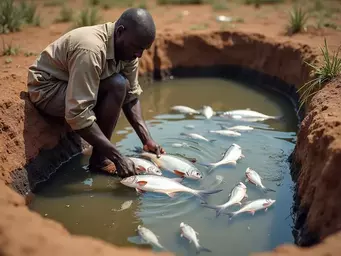
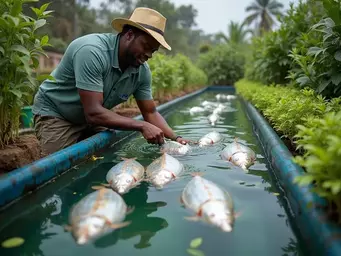
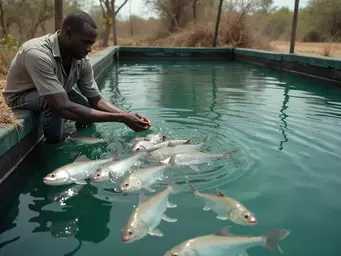
Picture this: You walk out to check your tilapia pond one morning and find dozens of fish gasping at the surface, their gills flared and damaged. Yesterday they were feeding normally, but overnight something went terribly wrong. You rush to test the water and discover ammonia levels have spiked to dangerous heights—your fish are literally being poisoned by their own waste.
📃 Table of Contents
This nightmare scenario unfolds across tilapia farms from Ghana to Tanzania, often catching even experienced farmers completely off guard. Ammonia and nitrite poisoning kills more tilapia than diseases, predators, and theft combined, yet these invisible killers remain poorly understood by many farmers. Poor water quality doesn't just cause fish deaths—it stunts growth, reduces feed efficiency, and makes your fish vulnerable to diseases that healthy fish would easily resist.
The tragedy is that most water quality disasters are completely preventable with proper knowledge and simple testing protocols. Managing ammonia and nitrite effectively isn't about expensive equipment or complex chemistry—it's about understanding practical testing methods, recognising warning signs before problems become critical, and implementing proven treatment strategies that work in African conditions. Whether you're running earthen ponds in rural Nigeria, concrete tanks in urban Kenya, or considering biofloc systems in South Africa, mastering these fundamentals protects your investment whilst maximising growth rates.
This comprehensive guide provides you with everything needed to test, monitor, and treat your pond water effectively. You'll learn safe concentration levels, practical testing procedures using affordable equipment, and proven treatment methods that prevent fish losses whilst maintaining optimal growing conditions. Master these water quality fundamentals, and you'll never again lose sleep worrying about invisible killers in your ponds.
🎯 What You'll Learn
- Master effective testing methods for ammonia and nitrite levels to ensure optimal water quality in your tilapia ponds
- Learn practical treatment strategies, including aeration and carbon source applications, to rapidly address ammonia and nitrite spikes
- Understand the nitrogen cycle and how to optimise biofiltration to maintain a sustainable and healthy tilapia farming system
Understanding Water Quality Parameters
Water quality in tilapia farming extends far beyond simply keeping the water clear – it involves maintaining a delicate balance of chemical parameters that directly impact fish health, growth rates, and survival. The most critical parameters you need to understand are ammonia and nitrite levels, but these don't exist in isolation from other water chemistry factors that influence your pond's overall ecosystem. Mastering these interconnected relationships forms the foundation of successful tilapia production.
Safe Ammonia and Nitrite Levels
Your tilapia can only tolerate specific concentration ranges of ammonia and nitrite before experiencing serious health impacts. For ammonia, you must maintain levels below 0.5 mg/L at all times, with optimal levels staying below 0.25 mg/L. Even experienced farmers in Kisumu have learned this lesson the hard way – one farmer lost 200 fish in a single week when ammonia spiked to 1.8 mg/L during the dry season when water exchange became difficult.
Nitrite levels require even stricter control, with safe concentrations staying below 0.1 mg/L for optimal fish health, though some sources suggest up to 1 ppm as acceptable in emergency situations. However, chronic exposure to nitrite levels above 0.5 mg/L will significantly impact growth rates and feed conversion efficiency. A tilapia farmer in Accra discovered this when his fish growth slowed dramatically despite adequate feeding – water testing revealed nitrite levels consistently running at 0.8 mg/L due to inadequate biofilter maintenance.
When ammonia and nitrite levels exceed safe ranges, your tilapia exhibit predictable stress symptoms that serve as early warning signs. Fish begin gasping at the water surface, lose their appetite, and develop brown or damaged gills. Growth rates slow significantly, and mortality increases, particularly among smaller fish and recently stocked fingerlings.
| Parameter | Safe Level (mg/L) | Optimal Level (mg/L) | Symptoms of Toxicity |
|---|---|---|---|
| Ammonia | 0.5 | 0.25 | Gasping, loss of appetite, damaged gills |
| Nitrite | 0.1 | 0.5 | Reduced growth rates, erratic swimming |
Key Water Quality Indicators
Beyond ammonia and nitrite, several interconnected parameters influence your pond's water chemistry and directly affect how toxic these compounds become to your fish. pH levels between 6.5 and 8.5 provide optimal conditions for tilapia, but pH also determines ammonia toxicity – higher pH levels make ammonia significantly more dangerous to fish. At pH 8.0 and 28°C, ammonia becomes nearly ten times more toxic than at pH 7.0.
Dissolved oxygen levels must remain above 5 mg/L throughout the day and night, with optimal levels staying above 6 mg/L. Low oxygen conditions not only stress fish directly but also impair the biological processes that convert ammonia to less harmful compounds. Temperature affects both oxygen solubility and ammonia toxicity – warmer water holds less oxygen while making ammonia more dangerous to fish.
Alkalinity and hardness provide buffering capacity that stabilises pH and supports the beneficial bacteria responsible for processing ammonia and nitrite. Total alkalinity should range between 50-150 mg/L as calcium carbonate equivalent, while hardness levels between 50-200 mg/L support healthy fish physiology and bacterial activity. These parameters work together as a system – managing one without considering the others often leads to unexpected water quality problems.
| Parameter | Optimal Range | Effect on Fish Health |
|---|---|---|
| pH | 6.5 - 8.5 | Affects ammonia toxicity |
| Dissolved Oxygen | > 5 mg/L | Improves fish behaviour |
| Temperature | 25 - 30 °C | Affects oxygen solubility |
| Alkalinity | 50 - 150 mg/L | Stabilises pH |
Environmental Factors Impacting Water Quality
External environmental conditions significantly influence ammonia and nitrite accumulation in your ponds, with seasonal changes creating predictable challenges that require proactive management. During hot, dry seasons common across much of Africa, water temperatures rise while water levels drop due to evaporation, concentrating waste products and reducing the pond's capacity to dilute toxic compounds. A farmer near Lusaka experienced this firsthand when his 200-square-metre pond lost 30% of its volume during a particularly harsh dry season, leading to ammonia spikes that required emergency water changes.
Rainy seasons present different challenges, as heavy rains can dramatically alter water chemistry through dilution, temperature changes, and runoff contamination. Sudden temperature drops during storms can shock beneficial bacteria populations, reducing their efficiency in processing ammonia and nitrite. Additionally, agricultural runoff during heavy rains can introduce excess nutrients that fuel algae blooms, creating oxygen depletion cycles that worsen ammonia problems.
Stocking density interacts with environmental factors to determine how quickly ammonia and nitrite accumulate in your system. Higher temperatures increase fish metabolism and waste production while reducing water's capacity to hold dissolved oxygen. This means that stocking densities that work well during cooler months may become problematic as temperatures rise.
| Factor | Effect on Water Quality | Management Strategies |
|---|---|---|
| Seasonal Changes | Higher temperatures concentrate waste | Increase water exchanges during dry season |
| Stocking Density | Increases waste accumulation | Monitor and adjust feeding rates |
The Nitrogen Cycle and Biofiltration
The nitrogen cycle represents the biological engine that processes fish waste and prevents toxic ammonia accumulation in your tilapia ponds. Understanding how this natural process works – and how to optimise it – gives you the power to maintain excellent water quality even at high stocking densities. This biological system relies on beneficial bacteria that convert harmful compounds into less toxic forms, but these bacteria require specific conditions to thrive and multiply.
Nitrification Process
Nitrification occurs through a two-step biological process carried out by different groups of beneficial bacteria that colonise surfaces throughout your pond system. The first step involves Nitrosomonas bacteria converting toxic ammonia into nitrite, while the second step uses Nitrobacter bacteria to convert nitrite into relatively harmless nitrate. Both bacterial groups require oxygen to function, which explains why well-aerated systems consistently maintain better water quality than poorly aerated ponds.
These beneficial bacteria establish colonies on all available surfaces in your pond – substrate, walls, plant roots, and filter media. A mature bacterial colony can process significant amounts of ammonia, but establishing these populations takes time. New ponds typically require 4-6 weeks to develop sufficient bacterial populations for effective ammonia processing, which explains why many farmers experience water quality problems during the first month after stocking.
Temperature, pH, and dissolved oxygen levels all influence bacterial activity and reproduction rates. Optimal conditions for nitrifying bacteria include temperatures between 25-30°C (perfect for tropical African conditions), pH levels between 7.5-8.5, and dissolved oxygen above 4 mg/L. When conditions fall outside these ranges, bacterial activity slows significantly, reducing the system's capacity to process ammonia and nitrite.
Biofilters and Their Function
Biofilters provide concentrated surface area where beneficial bacteria can establish dense colonies for maximum ammonia and nitrite processing capacity. The most effective biofilters use media with high surface area-to-volume ratios, such as plastic bio-balls, ceramic rings, or even locally available materials like crushed volcanic rock or fired clay pieces. A farmer in Kigali built an effective biofilter using 200 litres of ceramic rings in a flow-through container, processing water from his 1,000-square-metre pond at 50 litres per minute.
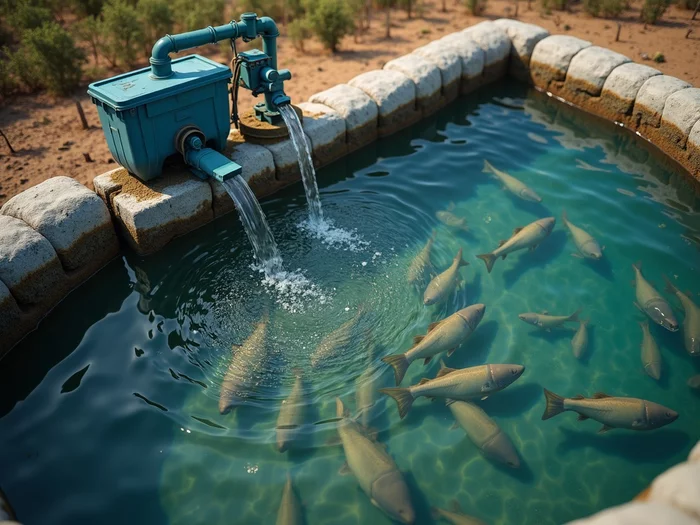
Simple biofilter designs work effectively for small to medium-scale tilapia operations without requiring expensive equipment or complex installations. A basic biofilter consists of a container filled with high-surface-area media through which pond water flows continuously. Water enters at the bottom, flows upward through the media where bacteria process ammonia and nitrite, then returns to the pond.
Biofilter maintenance involves regular cleaning to prevent clogging while preserving beneficial bacterial colonies. Clean filter media monthly by gently rinsing with pond water (never tap water, which contains chlorine that kills beneficial bacteria). Replace 25% of media every six months to maintain optimal surface area while preserving established bacterial populations.
Introduction to Biofloc Technology
Biofloc technology represents an advanced approach to water quality management that creates beneficial microbial communities directly in pond water, eliminating the need for external biofilters while providing additional nutrition for tilapia. This system works by maintaining specific carbon-to-nitrogen ratios that favour beneficial bacteria and microorganisms over harmful species. When properly managed, biofloc systems can support much higher stocking densities while maintaining excellent water quality.
Biofloc systems require adding carbon sources like molasses, wheat flour, or rice bran to maintain optimal carbon-to-nitrogen ratios between 15:1 and 20:1. Calculate carbon additions based on protein content of feed and feeding rates – for every kilogram of 30% protein feed, add approximately 0.6 kg of carbohydrate source. A farmer in Ibadan successfully operates a biofloc system in 500-square-metre ponds, stocking 200 tilapia per square metre while maintaining ammonia below 0.2 mg/L through careful carbon management and continuous aeration.
Successful biofloc management requires intensive monitoring and active system management, making it more suitable for farmers ready to commit significant time and attention to water quality. Daily monitoring includes pH, dissolved oxygen, ammonia, nitrite, and biofloc volume (measured by settling test). Maintain dissolved oxygen above 6 mg/L through continuous aeration, pH between 7.5-8.5 through alkalinity management, and biofloc volume between 10-15 mL/L through controlled feeding and carbon addition.
Testing and Monitoring Protocols
Effective water quality management depends entirely on accurate, regular testing that provides you with the information needed to make informed decisions about pond management. Without reliable testing data, you're essentially flying blind, unable to detect problems before they become fish losses or to verify that treatment methods are working effectively. Establishing systematic testing protocols ensures you catch water quality problems early while building the historical data needed to understand your pond's patterns and seasonal variations.
Practical Testing Methods
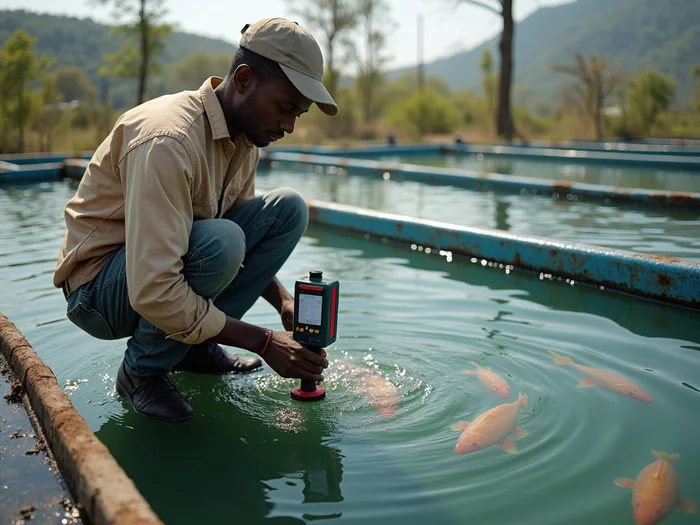
Field test kits provide the most practical solution for regular ammonia and nitrite monitoring on tilapia farms across Africa, offering reasonable accuracy without requiring expensive laboratory equipment or technical expertise. Digital colourimeter test kits offer the highest accuracy and are worth the investment for larger operations, typically costing 15,000-25,000 naira in Nigeria or 8,000-12,000 shillings in Kenya. For smaller operations, liquid reagent test kits provide adequate accuracy at lower cost, usually ranging from 3,000-5,000 naira or 2,000-3,500 shillings.
To test ammonia levels using liquid reagent kits, collect water samples from multiple points around your pond at consistent depths (30 cm below surface works well for most applications). Fill the test vial to the marked line, add the specified number of drops from each reagent bottle, cap and shake vigorously for 30 seconds, then wait the specified time before comparing colour to the chart. Read results in good natural light, as artificial lighting can affect colour perception and lead to inaccurate readings.
Nitrite testing follows similar procedures but typically requires different reagents and longer development times. Always test both ammonia and nitrite simultaneously, as these parameters often change together and provide more complete information about your pond's biological processes. Record all test results with date, time, weather conditions, and any observations about fish behaviour or feeding response.
Interpreting Test Results
Understanding what test results mean for your fish and what actions to take requires knowledge of both safe parameter ranges and how quickly conditions can change in tilapia ponds. Ammonia levels below 0.25 mg/L indicate excellent water quality with no immediate action required, while levels between 0.25-0.5 mg/L suggest increased monitoring frequency and preparation for potential treatment. Levels above 0.5 mg/L require immediate action to prevent fish stress and potential losses.
When interpreting results, consider the interconnected nature of water quality parameters and recent pond management activities. Rising ammonia levels often precede nitrite spikes by 3-7 days, as the first stage of bacterial processing converts ammonia to nitrite faster than the second stage converts nitrite to nitrate. If you detect rising ammonia, prepare for potential nitrite increases and monitor more frequently.
Fish behaviour provides crucial supplementary information for interpreting test results and determining urgency of response. Healthy tilapia actively feed, swim throughout the water column, and show normal colouration. Early signs of ammonia or nitrite stress include reduced feeding response, fish gathering near aeration sources or at the water surface, and pale or darkened colouration.
Long-term Monitoring Strategies
Establishing consistent monitoring schedules provides the foundation for proactive water quality management and helps you understand your pond's unique patterns and seasonal variations. For newly established ponds or systems with stocking densities above 100 fish per square metre, test ammonia and nitrite daily for the first month, then reduce to every other day once stable patterns emerge. Mature, lightly stocked systems may require testing only 2-3 times per week under normal conditions.
Increase testing frequency during predictable stress periods, including the first month after stocking, during hot weather, after heavy feeding, and following any system changes or treatments. Many successful farmers double their testing frequency during these periods, allowing early detection of problems before they become critical. A tilapia farmer in Kumasi tests daily during the hot season (December-March) and after any pond management activities, but reduces to twice weekly during stable periods.
Consider automated monitoring systems for larger operations or when managing multiple ponds simultaneously. Basic automated systems monitoring dissolved oxygen, pH, and temperature cost 50,000-80,000 naira in Nigeria or 35,000-55,000 shillings in Kenya, with more advanced systems including ammonia monitoring available at higher costs. While automated systems provide continuous data and can trigger alarms for critical conditions, they require regular calibration and maintenance.
Treatment and Remediation Methods
When water quality testing reveals elevated ammonia or nitrite levels, swift and appropriate treatment can mean the difference between minor production setbacks and catastrophic fish losses. Effective treatment requires understanding multiple intervention methods and selecting the most appropriate approach based on your specific situation, available resources, and the severity of the problem. The key to successful treatment lies in addressing root causes while providing immediate relief for stressed fish.
Aeration Techniques
Increasing dissolved oxygen levels through enhanced aeration provides the most fundamental and effective treatment for elevated ammonia and nitrite levels, as oxygen is essential for the bacterial processes that convert these toxic compounds to less harmful forms. Adequate aeration also directly benefits stressed fish by improving their ability to process waste products and recover from toxic exposure. Most successful tilapia farmers consider aeration the first line of defence against water quality problems.
Paddlewheel aerators provide excellent water circulation and oxygen transfer for larger ponds, typically requiring 1-2 horsepower per 1,000 square metres of pond surface area. A farmer in Kaduna operates three 0.5-horsepower paddlewheels in his 1,500-square-metre pond, running them continuously during hot weather and for 12-16 hours daily during cooler periods. Initial investment costs range from 80,000-120,000 naira per unit, but the improved water quality and increased stocking capacity typically justify the expense within one production cycle.
Diffuser aeration systems work effectively for smaller ponds and provide more efficient oxygen transfer per unit of energy consumed. Install air stones or diffuser tubes at pond bottom, spacing them every 10-15 metres for uniform coverage. A 2-horsepower blower can effectively aerate 500-800 square metres of pond area, depending on depth and stocking density.
| Technique | Description | Pros | Cons |
|---|---|---|---|
| Paddlewheel Aerators | Circulates and aerates large ponds | Effective for large areas | High energy costs |
| Diffuser Aeration Systems | Uses air stones for oxygen transfer | Efficient oxygen transfer | Requires regular maintenance |
Use of Carbon Sources
Adding carbon sources to pond water enhances beneficial bacterial activity and helps establish the microbial communities needed for effective ammonia and nitrite processing. Carbon additions work by providing energy for bacterial growth and reproduction, allowing bacterial populations to expand rapidly in response to increased ammonia loads. This approach proves particularly effective in new ponds or systems where bacterial populations haven't fully established.
Molasses provides an excellent, readily available carbon source for enhancing bacterial activity, typically applied at rates of 10-20 mg/L of pond water. Calculate the required amount by multiplying pond volume by desired concentration – a 1,000-cubic-metre pond requires 10-20 kg of molasses for each application. Dilute molasses in pond water before application to ensure even distribution, and apply during daylight hours when oxygen levels are typically higher.
Alternative carbon sources include wheat flour, rice bran, or even sugar, though molasses typically provides the best value and availability across most African markets. Monitor dissolved oxygen carefully after carbon applications, as bacterial activity increases oxygen consumption. Increase aeration for 24-48 hours following carbon additions to prevent oxygen depletion.
| Source | Application Rate (mg/L) | Benefits | Considerations |
|---|---|---|---|
| Molasses | 10-20 | Enhances bacterial growth | Monitor oxygen levels after application |
| Wheat Flour | 15-25 | Readily available alternative | May cloud water temporarily |
Chemical Treatments
Chemical treatments provide rapid intervention options for severe ammonia or nitrite problems, though they should be used judiciously and with understanding of their limitations and potential side effects. Zeolite, a natural mineral, effectively absorbs ammonia from water and can provide immediate relief while biological treatment methods take effect. Natural zeolite works through ion exchange, trading harmless sodium or potassium ions for toxic ammonia molecules.
Apply zeolite at rates of 50-100 grams per cubic metre of pond water for moderate ammonia problems, or up to 200 grams per cubic metre for severe cases. Place zeolite in mesh bags or permeable containers positioned in high-flow areas near aeration sources for maximum effectiveness. Zeolite requires regeneration every 2-4 weeks by soaking in strong salt solution (300 grams salt per litre water) for 24 hours, then rinsing thoroughly before reuse.
Salt applications can provide temporary relief for nitrite toxicity by blocking nitrite uptake through fish gills, though this represents a short-term solution while addressing underlying causes. Apply non-iodised salt at 1-3 kg per 1,000 litres of water for nitrite emergencies, monitoring fish behaviour closely for signs of improvement or stress. Maintain salt treatment for 3-7 days while implementing other corrective measures, then gradually reduce salt concentration through water changes.
Practical Strategies for Ammonia and Nitrite Management
Long-term success in managing ammonia and nitrite levels requires implementing comprehensive management strategies that prevent problems rather than simply treating them after they occur. These proactive approaches address the fundamental factors that influence waste production and processing capacity in your tilapia system. By managing stocking density, feeding practices, and water chemistry proactively, you create conditions that naturally maintain excellent water quality.
Stocking Density Considerations
Stocking density directly determines the rate at which ammonia and other waste products accumulate in your pond system, making it one of the most critical management decisions affecting long-term water quality. Higher stocking densities increase waste production exponentially, not linearly, because fish stress and competition reduce feed efficiency while increasing metabolic waste production per unit of growth. Understanding the relationship between stocking density and waste production helps you select appropriate densities for your management capacity.
Conservative stocking densities of 50-75 tilapia per square metre provide excellent margins of safety for most pond systems, allowing biological filtration to keep pace with waste production even during challenging conditions. These densities work particularly well for farmers new to intensive tilapia production or those with limited monitoring and treatment capabilities. A farmer in Tamale successfully maintains these densities in earthen ponds with minimal aeration, achieving consistent harvests of 2-3 kg per square metre every six months.

Higher stocking densities of 100-200 fish per square metre become feasible with enhanced aeration, biofilter systems, and intensive monitoring protocols. These systems require daily water quality testing, backup aeration capacity, and immediate response capabilities for water quality emergencies. The increased production potential justifies the additional management requirements, but farmers must be prepared for the intensive attention these systems demand.
Mastering ammonia and nitrite management forms the cornerstone of successful tilapia farming, and you now possess the essential knowledge to maintain healthy water conditions that support optimal fish growth and survival. Start with regular testing using affordable field kits, maintain dissolved oxygen above 6 mg/L through adequate aeration, and keep stocking densities conservative until your biological filtration systems mature. Remember that prevention through proper feeding management and biofilter maintenance costs far less than emergency treatments and fish replacement.
Your success depends on developing consistent monitoring routines and learning to read early warning signs before test kits confirm problems. Fish behaviour often provides the first indication of deteriorating water quality—reduced feeding response, surface gasping, or sluggish movement signal immediate attention needed. Don't be discouraged if managing these parameters feels overwhelming initially; every experienced tilapia farmer has faced water quality challenges while learning their system's patterns and seasonal variations.
As your confidence grows with hands-on experience, you'll develop an intuitive understanding of your pond's unique characteristics and requirements. This water quality foundation prepares you to tackle more advanced production techniques like optimising feeding strategies and increasing stocking densities safely. Consider exploring integrated aquaculture systems or biofloc technology as next steps—both build upon the solid water management principles you've learned here.
Frequently Asked Questions
Why do ammonia and nitrite levels often spike in my pond during the first month after stocking?
New ponds often experience ammonia spikes because it takes 4-6 weeks for sufficient beneficial bacteria populations to establish themselves and effectively process fish waste. These bacteria are crucial for converting toxic ammonia into less harmful compounds through the nitrification process. Monitoring closely and potentially adding carbon sources can help during this critical period.
How can I tell if my tilapia are stressed by high ammonia or nitrite, even before I test the water?
Your tilapia will show predictable stress symptoms. Look for fish gasping at the water surface, a noticeable loss of appetite, and sluggish behaviour. Their gills might also appear brown or damaged, indicating severe issues.
What are some readily available and affordable carbon sources I can use to boost beneficial bacteria in my pond?
Molasses is an excellent and widely available carbon source, typically applied at rates of 10-20 mg/L of pond water. Other alternatives include wheat flour, rice bran, or even sugar, all of which provide energy for bacterial growth. Always monitor dissolved oxygen carefully after application and increase aeration if needed.
Can I use tap water to clean my biofilter media?
No, you should never use tap water to clean your biofilter media. Tap water often contains chlorine, which will kill the beneficial bacteria essential for processing ammonia and nitrite in your pond. Instead, gently rinse the filter media with pond water to remove clogs while preserving the bacterial colonies.
What's the fastest way to lower very high ammonia levels in my pond during an emergency?
For immediate relief in severe ammonia problems, you can apply zeolite at rates of 50-100 grams per cubic metre of pond water, or up to 200 grams for extreme cases. Place it in mesh bags in high-flow areas. Simultaneously, increasing aeration is crucial as oxygen is vital for the bacteria that convert ammonia.


Yomi Adisa Lead Researcher
Yomi Adisa is the lead researcher at Fish Farming Business, where he studies what makes aquaculture ventures profitable across Africa. His research focuses on market patterns, buyer preferences, and the business decisions that determine success or failure in fish farming.